ownership · offline-first · saas · data · pakistan · business
You Don't Own That Software. You're Renting It.
Every CMS, PMS, and HRMS you pay for monthly leaves you a tenant in someone else's building. Offline-first isn't a feature choice — it's a property rights argument, and it's why I built Aafiyat the way I did.
TL;DR: Every CMS, PMS, and HRMS you’re paying for monthly — you don’t own any of it. Your data lives on someone else’s server. Their downtime is your crisis. Offline-first development is the direct answer to this, and it’s exactly why I built Aafiyat the way I did.
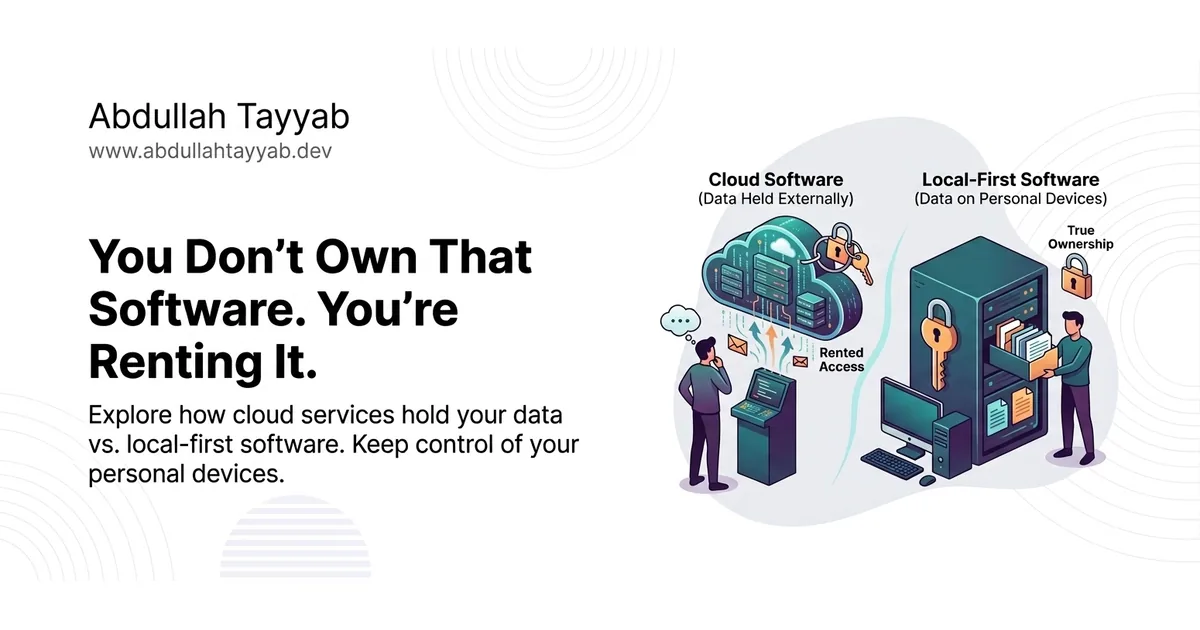
The Tenant Metaphor Nobody Talks About
When you rent an apartment, the walls, the wiring, and the plumbing belong to the landlord. You pay monthly. You follow their rules. If the building has a water outage, you wait. When you move out, you leave empty-handed.
Most businesses are doing the exact same thing with their software — and calling it “going digital.”
Cloud-based practice management systems. HR portals. Complaint management dashboards. Inventory tools. Every one of them follows the same model: you pay a monthly subscription, log in through a browser, and use the system. But the system is never yours.
The company that built it owns the servers. They own the database schema. They own the uptime SLA. And — whether their terms say it plainly or bury it in legalese — they own the conditions under which you can access your own data.
What “Owning” Software Actually Means
There’s a quiet assumption in the SaaS world that cloud = modern and local = outdated. That assumption has been very profitable for software companies and very costly for their users.
Think about what you actually control when you use a typical web-based portal:
- The server goes down? You wait. You can’t work. Support tickets go unanswered.
- The company raises prices? You pay or you migrate — and migration usually means data exports in formats that are barely usable.
- The company shuts down? You scramble. Exports, if they exist at all, come with no guarantee of structure or completeness.
- Your internet is unstable? The app is a blank screen. Nothing loads. Nothing saves.
None of these are edge cases. They are routine realities for businesses in Pakistan — and for many businesses globally. Load-shedding isn’t a niche problem here. Patchy mobile internet isn’t a niche problem. And yet the entire SaaS industry builds as though a reliable 50 Mbps connection is a given.
The software companies aren’t doing anything illegal. You agreed to their terms. But the power dynamic is worth naming clearly: the software vendor is the owner; the paying user is the subscriber.
Offline-First Is a Property Rights Argument
When I talk about offline-first architecture, most developers hear a technical preference. What I’m actually describing is a different relationship between software and its user.
An offline-first application is built so that the primary source of truth is the user’s own device. The data lives locally — on a hard drive the user physically owns. The application logic runs locally. Work continues whether the internet is up or down. When connectivity returns, the system syncs — but the sync is a convenience, not a dependency.
This flips the tenant model entirely.
You don’t need the vendor’s server to be up. You don’t need a subscription to access data you entered six months ago. You don’t need anyone’s permission to open the application and do your work. The software is yours because the data is yours and the runtime is yours.
This is what ownership of software actually looks like.
Why I Built Aafiyat This Way
Aafiyat is a patient management system I built for private clinics in Pakistan. SOAP consultations, prescriptions, billing, appointment scheduling, full patient records — the complete front-desk and clinical workflow.
I built it as an Electron desktop application backed by SQLite, with Supabase handling cloud sync when the clinic is online.
The decision wasn’t academic. It came from watching how clinics here actually operate. A clinic in a small city doesn’t have a guaranteed broadband connection. The doctor sees patients whether the internet is working or not. A billing system that throws a “connection error” at 11 AM on a busy day isn’t just inconvenient — it breaks the entire workflow and erodes trust in digital tools entirely.
With Aafiyat, the clinic owns the installation. The data lives in a SQLite file on their machine. If their ISP has an outage, the system keeps running. If they stop paying for cloud sync, their historical records are still fully accessible. The software doesn’t hold their data hostage.
When the internet is available, Supabase syncs the data — giving them backup, multi-device access, and recovery options. But the sync is additive. It’s not the foundation.
This is the distinction: in most SaaS tools, the cloud is the foundation and offline is a bonus feature (if it exists at all). In Aafiyat, local is the foundation and cloud is the enhancement.
The clinic is the owner. Not the vendor.
The Harder Question
If offline-first is more resilient, why isn’t every software built this way?
The honest answer: it’s harder to build, and it doesn’t support the subscription revenue model as cleanly.
A desktop application with local data doesn’t give the vendor a daily lever over the user. There’s no “your account has been suspended” email. There’s no “upgrade to access your archives.” The vendor builds the software, sells it, and the user runs it. That’s it.
For the user, that’s power. For a venture-funded SaaS company optimizing for monthly recurring revenue, that’s a problem.
I’m not building for that model. I’m building for clinics in Nankana Sahib and businesses across Pakistan that need software which works — consistently, reliably, without conditions.
Your Data. Your Server. Your Rules.
The next time a sales page tells you their platform is “enterprise-grade” and “always available,” ask the harder question: available on whose terms?
If the answer is “ours, subject to our uptime SLA and our pricing changes,” you’re looking at a rental agreement with extra steps.
Ownership looks different. It’s quieter. It doesn’t need to promise 99.9% uptime because the uptime doesn’t depend on someone else’s infrastructure. It doesn’t need to promise data portability because your data never left your hands.
That’s the case I’ll keep making, and it’s the architecture I’ll keep building toward.
If You Only Remember One Thing
The question to ask about any piece of software is not how good is it? It’s who can take it away from me?
A tool that works beautifully but disappears on a vendor’s schedule is a favour. A tool that’s plain but stays yours forever is an asset. For a clinic keeping patient records, or a shop keeping stock records, or an office keeping HR records — that difference compounds quietly, year after year.
Part 2 of This Series
This is Part 1 of a two-part series on software ownership. Part 2 goes into the economics:
One-Time Payment vs. Monthly Subscription: The Math They Don’t Show You — what a Rs. 1,500/month subscription actually costs over three years once annual increases compound, when subscriptions genuinely are the right call, and the exit cost nobody puts in the comparison.
If you’re running a clinic, shop, or office on rented software and want to know what ownership would actually look like for your workflow, I’d like to hear about it.
Start that conversation at abdullahtayyab.dev — or check what I’m currently building at abdullahtayyab.dev/now.
Abdullah Tayyab — Full-Stack Developer, Punjab, Pakistan.
Enjoyed this? Say hello →
Comments
Loading comments…
Comments are reviewed before they appear. No account needed.