pricing · saas · business · pakistan · ownership · saas-economics
One-Time Payment vs. Monthly Subscription: The Math They Don't Show You
A Rs. 1,500/month subscription costs more than it looks once annual increases compound. Here's the three-year arithmetic, when subscriptions genuinely are the right call, and the exit cost nobody prices in.
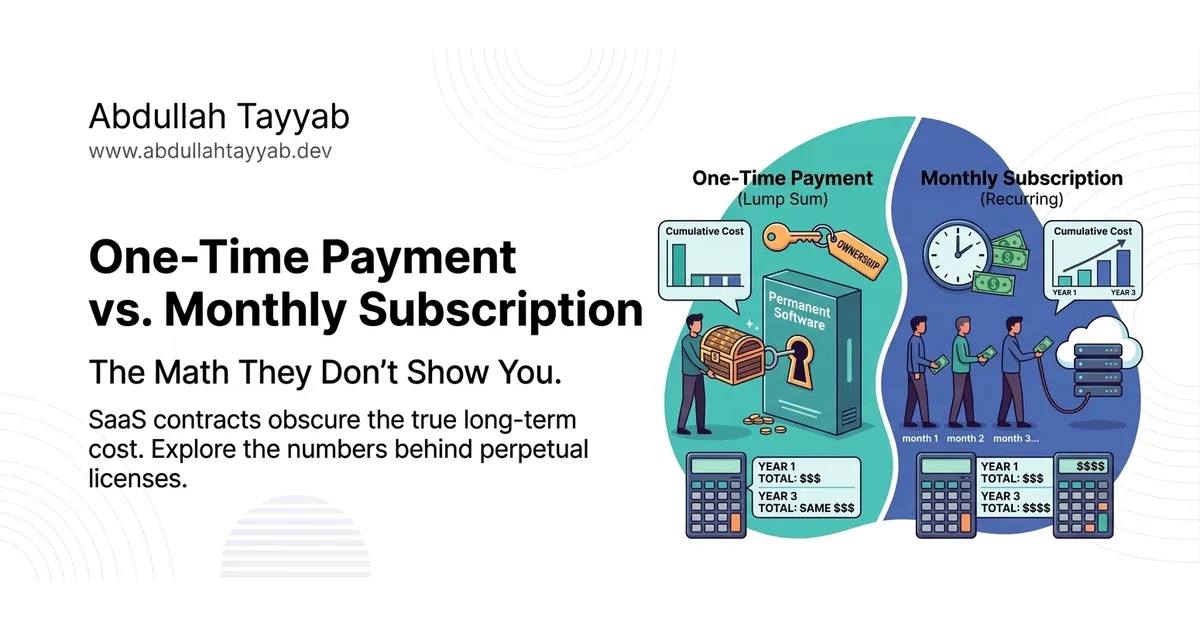
TL;DR: Monthly subscriptions look affordable until you run the numbers over three years — and factor in annual price hikes that quietly outpace inflation. One-time payment software costs more upfront, but it’s the only model where the price doesn’t keep rising while your ownership stays the same.
The Rs. 1,500 That Becomes Rs. 3,000
Here’s how the conversation usually goes when someone is choosing software for their clinic, shop, or office:
“It’s only Rs. 1,500 a month. That’s nothing.”
And it is nothing — in month one.
But software vendors don’t freeze their prices. They can’t. Their servers cost more every year. Their staff salaries go up. The dollar exchange rate moves against them, and since most cloud infrastructure is billed in USD, every rupee devaluation hits their cost base directly. So they pass it on — quietly, usually buried in an email you skim past.
A Rs. 1,500/month subscription today is not a Rs. 1,500/month commitment. It’s an open-ended obligation with a price that will move upward, on a schedule you don’t control, for as long as you depend on the software.
Run the numbers plainly:
| Period | Monthly Rate | Annual Cost |
|---|---|---|
| Year 1 | Rs. 1,500 | Rs. 18,000 |
| Year 2 | Rs. 2,000 | Rs. 24,000 |
| Year 3 | Rs. 2,500 | Rs. 30,000 |
| 3-year total | Rs. 72,000 |
These aren’t dramatic numbers. A 25–33% annual increase is not unusual for software subscriptions in Pakistan when you account for rupee depreciation, inflation, and the vendor’s own growth costs. Some go higher.
At the end of three years, you have spent Rs. 72,000. You own nothing. If you cancel, your data is in their hands and your workflow is gone.
Why Monthly Subscriptions Feel Cheaper (By Design)
Subscription pricing isn’t an accident. It’s a deliberate framing strategy.
Rs. 1,500/month sounds manageable. Rs. 18,000/year sounds like a decision. Rs. 72,000 over three years sounds like a commitment you’d want to evaluate carefully. All three numbers describe the same thing — but the monthly framing consistently wins because it maps to how we think about small, recurring expenses.
Telecom companies have used this model for decades. Streaming services perfected it. SaaS vendors learned from both.
The monthly frame also obscures the compounding effect of price increases. If the vendor raises your rate once a year, you’re not comparing a new annual number against the old one — you’re just paying a slightly higher monthly bill that doesn’t feel dramatically different from last month’s.
This is the trap. Not a conspiracy — just a pricing model that works very well for vendors and costs users more than they realize.
What a One-Time Payment Actually Buys
One-time payment software has a different premise: you pay for the software once, and it runs. The price is fixed at the moment of purchase. There are no renewal emails, no “your subscription will auto-renew at the new rate” notifications, no service suspensions if a payment fails.
Yes, the upfront number is larger. A system priced at Rs. 25,000 or Rs. 40,000 as a one-time license looks steep against Rs. 1,500/month. That’s the comparison the subscription vendor wants you to make.
But the one-time payment number doesn’t move. It doesn’t adjust for inflation. It doesn’t respond to the dollar rate or the vendor’s server costs. You paid it once. It’s done.
Using the same three-year window:
| Model | Year 1 | Year 2 | Year 3 | Total |
|---|---|---|---|---|
| Subscription (with increases) | Rs. 18,000 | Rs. 24,000 | Rs. 30,000 | Rs. 72,000 |
| One-time license | Rs. 35,000 | Rs. 0 | Rs. 0 | Rs. 35,000 |
| Subscription, cumulative | Rs. 18,000 | Rs. 42,000 | Rs. 72,000 | |
| One-time, cumulative | Rs. 35,000 | Rs. 35,000 | Rs. 35,000 |
The one-time payment crosses over around month 21. By Year 3, it has saved nearly Rs. 37,000 — and the savings keep compounding every year the software continues to run.
The hard part is Year 1. That Rs. 35,000 requires a real decision, not a low-friction signup flow. That psychological weight is real, and it’s the primary reason subscription software wins at the point of sale even when it loses over time.
The Inflation Argument Nobody Mentions
There’s a layer to this that goes beyond software pricing specifically.
Pakistan’s inflation rate has been significant and persistent. The rupee has lost substantial value against the dollar over the past several years. This matters because most cloud infrastructure — AWS, Google Cloud, DigitalOcean, Supabase’s paid tiers — is priced in USD. When a Pakistani software vendor’s hosting costs double in rupee terms, that increase finds its way into your subscription, usually within a billing cycle or two.
One-time payment software — especially software that runs locally on your own hardware — is largely insulated from this. The purchase price was fixed at the exchange rate that existed when you bought it. The software doesn’t care what the dollar is doing today. It runs on your machine.
This is exactly the model I designed Aafiyat around. The clinic pays once. The software runs on their machine. Their operational costs don’t fluctuate based on currency markets or a vendor’s infrastructure decisions. The software they installed on Day 1 is the software they’re running on Day 1,000, and the cost hasn’t moved.
When Subscriptions Do Make Sense
I’m not arguing that subscriptions are always the wrong choice. They are the right model in specific situations:
- When the software genuinely requires continuous cloud infrastructure — real-time multi-branch synchronization, live analytics across hundreds of devices, AI-powered features that run server-side. These aren’t things you can run locally, and the subscription price reflects real ongoing costs.
- When you’re testing before committing — a monthly subscription lets you validate whether a tool actually fits your workflow before a large purchase. The trap is staying on the subscription after you’ve validated it.
- When the software is updated constantly and updates are the core value — security tools, threat intelligence platforms, anything where the data feeding the software changes daily. Here the subscription is paying for current information, not just software access.
For most small business software in Pakistan — clinic management, inventory, HR, point-of-sale — none of these conditions apply. The core features don’t require live server computation. The data is yours. The workflow is local. The subscription model here is a revenue optimization for the vendor, not a functional requirement.
The Exit Cost Nobody Prices In
There’s one more cost in the subscription model that rarely shows up in the comparison: the cost of leaving.
With subscription software, your data lives in the vendor’s database, in their schema, in their format. When you cancel — or when they raise prices past what you’ll pay, or when they shut down — you need to export your data. If the export exists, it’s often a raw CSV that doesn’t map cleanly to any other system. Migration means manual work, lost records, or paying someone to clean and reformat the data.
With locally-owned software, this problem mostly doesn’t exist. Your data is already in your hands. You always had it. There’s no exit negotiation because there was no lock-in to begin with.
This is the hidden line item in every subscription contract: an exit tax measured in time, lost data, and migration costs that only materializes when you’re already frustrated enough to leave.
The Honest Upfront Conversation
When I talk to a potential client about Aafiyat, I don’t pitch the one-time price as a discount. It’s not always cheaper in the first six months. For some clinics, the monthly payment of a competitor’s system is easier to absorb in the short term.
What I do say is this: tell me your three-year plan.
If you’re planning to use practice management software for the next three to five years — and you are, because switching is painful — the one-time price will cost you less in rupees, will never increase, and will leave you in full control of your data regardless of what any vendor decides to do with their pricing, their servers, or their company.
That’s not a sales pitch. It’s arithmetic.
Part 1 of this series
Part 1 covered why most business software puts you in the position of a tenant, not an owner — and how offline-first architecture changes that.
Read Part 1: You Don’t Own That Software. You’re Renting It.
If you have a clinic, shop, or office currently paying monthly for software that doesn’t work when the internet doesn’t, I’d like to hear about it.
Start that conversation at abdullahtayyab.dev — or check what I’m currently building at abdullahtayyab.dev/now.
Abdullah Tayyab — Full-Stack Developer, Punjab, Pakistan.
Enjoyed this? Say hello →
Comments
Loading comments…
Comments are reviewed before they appear. No account needed.